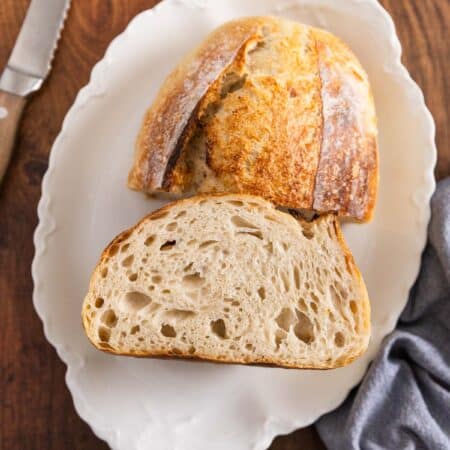
Easy Same-Day Sourdough Bread
Servings 14 slices
Calories 135kcal
Ingredients
- 100 g sourdough starter (active, but not necessarily at peak)
- 350 g water (room temperature, not cold)
- 500 g bread flour
- 11 g fine sea salt or pink Himalayan salt (may reduce to taste)
Instructions
- Stir the sourdough starter and water together in a large bowl. Add the bread flour and salt and mix until no dry flour remains. The dough will be rough and shaggy.
- Using your hand, knead the dough right in the bowl for about 5 minutes. It will start out sticky but should gradually become smoother, stronger, and less sticky. Cover and rest for 30 minutes.
- With damp hands, stretch one side of the dough up and fold it over the center. Turn the bowl and repeat on all four sides. Cover and rest for 30 minutes. Repeat for a total of 4 sets of stretch and folds, 30 minutes apart.
- After the final stretch and fold, cover the dough and let it rise for about 4–5 hours, or until it has noticeably increased in volume, looks airy and slightly domed, has visible bubbles, and jiggles when the bowl is gently moved.
- Turn the dough onto a lightly floured counter and gently shape it into a loose round. Let it rest uncovered for 30 minutes.
- Shape the dough into a tight round or oval and place it seam-side up in a well-floured banneton. Cover and place in the freezer for 20–30 minutes.
- While the dough chills, preheat the oven to 450°F with a Dutch oven or covered roasting pan inside.
- Turn the chilled dough onto a sheet of parchment paper and score the top with a bread lame or sharp razor blade.
- Carefully lower the dough and parchment into the hot pan. Bake for 25-30 minutes. Remove the lid and bake uncovered for another 15–20 minutes, until deeply golden brown.
- Transfer to a wire rack and cool for at least 1 hour before slicing.
Notes
- The rest and rise time accounts for the 30 minute initial rest, 1 1/2 hours between stretch-and-fold sets, roughly 4–5 hours of bulk fermentation, 30 minute bench rest, and 20–30 minute freezer rest.
- Your starter should be active, bubbly, and have risen after feeding, but it does not have to be exactly at peak.
- I use 350 g for a beginner-friendly dough that's easier to handle. Once you're comfortable with sourdough, you can increase the water to 360 g for a slightly higher-hydration loaf.
- Use the 4–5 hours as a guideline, not a rule. A warm kitchen will ferment faster and a cold kitchen may take longer. Watch the dough, not the clock.
- If your kitchen is cool, place the covered dough in your turned-off oven with just the oven light on during bulk fermentation.
- The 20–30 minute freezer rest firms up the dough and makes it much easier to score. It should be chilled, not frozen solid.
- Don't slice the loaf while it's hot. Give it at least an hour for the crumb to finish setting.
Nutrition
Serving: 1 slice | Calories: 135kcal | Carbohydrates: 27g | Protein: 4g | Fat: 1g | Saturated Fat: 0.1g | Polyunsaturated Fat: 0.3g | Monounsaturated Fat: 0.05g | Sodium: 307mg | Potassium: 36mg | Fiber: 1g | Sugar: 0.1g | Vitamin A: 1IU | Calcium: 6mg | Iron: 0.3mg